
After a long summer break, it is finally time to return to the blog.
We spent much of our summer in Finland, surrounded by family, relatives, and—most importantly from a language perspective—Finnish. For my daughter, this meant weeks of natural immersion. Finnish was everywhere: in conversations with family, during play, while shopping, watching TV, and simply going about everyday life.
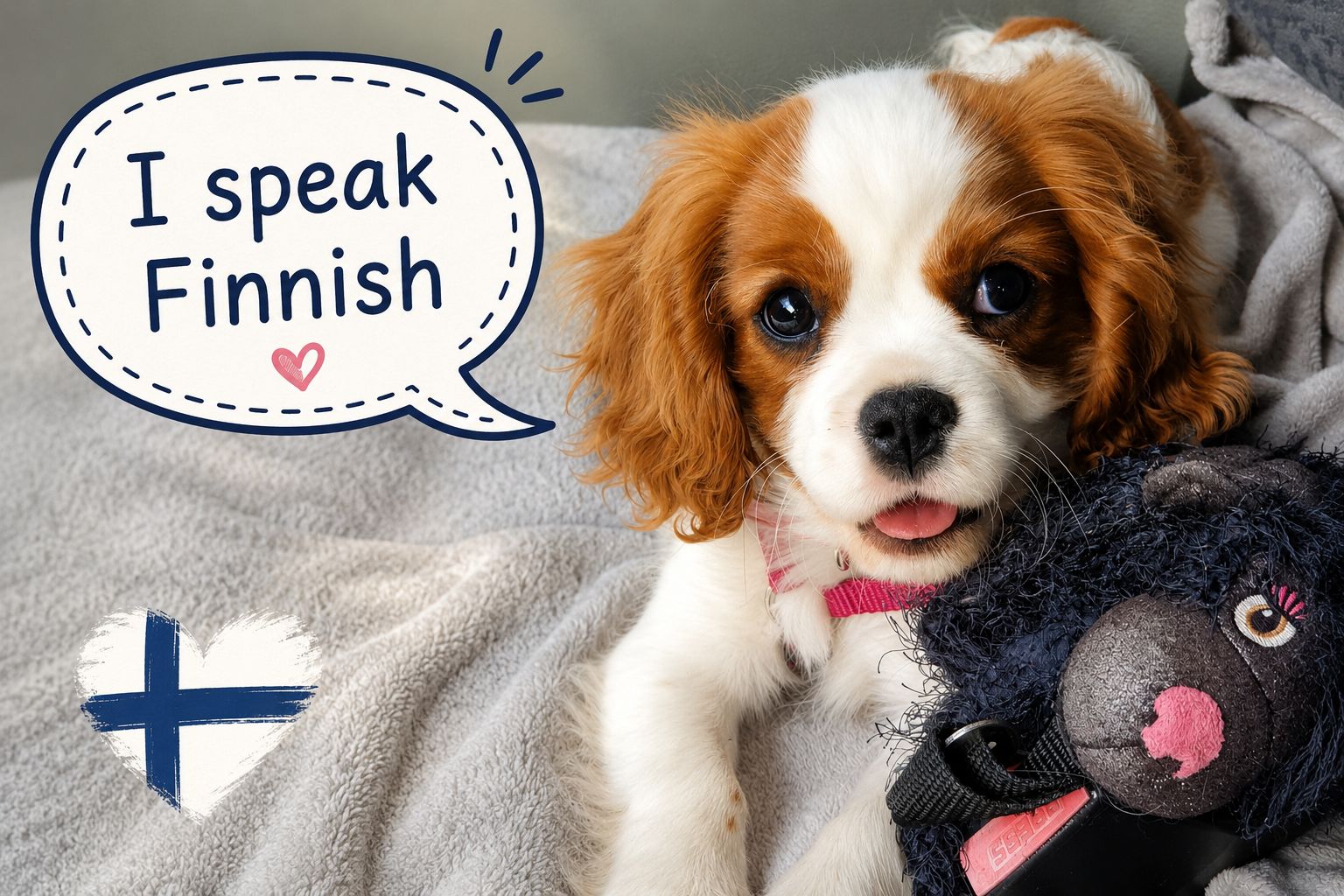
Soon after returning to Dubai, our family also grew by one. We welcomed a Cavalier King Charles Spaniel puppy into our home. And, somewhat unexpectedly, he has already found his own role in our family language strategy.
From Finnish immersion back to English
Returning to Dubai means another change in my daughter’s language environment. Interestingly, despite spending a long period immersed mainly in Finnish, I noticed no real loss of English. She switched back to English immediately.
Finnish is a different story.
Once school starts, English will again dominate much of her day. She attends an English-medium school, speaks English with friends, and encounters English almost everywhere outside our home. Like many expatriate families, we don’t have the option of having our heritage language taught at her regular school.
So the question becomes: How do we make sure Finnish continues to have a meaningful place in her everyday life?
Heritage language needs more than lessons
Families in this situation often have several options. Children can attend weekend language schools, join heritage-language groups, or take online classes. These can be particularly valuable for developing literacy and providing regular, structured exposure to the language.
But formal learning is only one part of heritage language maintenance.
Children also need opportunities to use the language naturally and for a real purpose. Talking to grandparents, playing with other Finnish-speaking children, reading together, watching Finnish programs, and visiting Finland all help create a reason for Finnish to remain part of everyday life.
Sometimes, however, opportunities can come from unexpected places.
Like a puppy.
Why our puppy speaks Finnish
When our puppy joined the family, we decided to train him only in Finnish.
His commands are in Finnish, and when we talk to him, we try to use Finnish as much as possible. What I particularly like about this arrangement is that it was important to my daughter too. To her, it simply made sense that our puppy should understand Finnish. He is part of our family, so naturally he should know our family language.
Of course, teaching a puppy istu instead of sit is not going to maintain a child’s heritage language on its own. But the idea behind it matters. We have created another small space in our everyday life where Finnish has a purpose.
My daughter does not have to think of Finnish as something she needs to “practice.” Finnish is simply the language she uses when calling the puppy, giving him commands, praising him, playing with him, and talking about what he is doing.
Create reasons to use the language
For expatriate families trying to maintain a heritage language, perhaps one of the most useful questions is not simply:
How can my child get more language lessons?
Instead, we can also ask:
How can we create more situations where this language is naturally useful?
The answer will look different in every family. It might be regular video calls with grandparents, friendships with families who speak the same language, books and audiobooks, visits to the home country, online classes, or simply making the heritage language the language of certain family activities.
And sometimes, it might even be getting a puppy who only understands the heritage language.
Leave a Reply